
The Institute of Mental Resources has launched a series of mega-models for the “Sense of the World”!
The seventh “Beijing Congress of the Wise” was opened on 6 June at the Beijing Summit. As an annual gathering in the area of artificial intelligence, the conference attracted a wide range of industry experts, academics and business representatives to discuss recent developments and future trends in AI technology. At the Congress, the Beijing Institute of Intellectual Intelligence published a series of mega-models on the subject.

The Big Sensitivity Model covers a number of front-line technological outcomes, including the original multimodular world model Emu3, the multimodular general base model for brain science, see Microbrainmi, the cross-book body-size brain collaboration framework RoboOS 2.0, the brain-brain RoboBrain 2.0 and the all-atom microlife model OpenComplex2.
Emu3 is a highly integrated, multi-modular world model capable of processing multiple data models, such as text, images and videos, at the same time, to achieve cross-modular understanding and generation. Compared to the traditional single-state model, Emu3 significantly enhanced the model ‘ s perception and reasoning of complex scenarios through a unified architecture. Its applications include intelligent dialogue, content generation and virtual reality interaction, which demonstrates the powerful potential of multimodular AI in the actual scene.
RoboOS 2.0 is a framework for cross-incorporated brain-size collaboration designed specifically for robots and intelligents, optimizing the teamwork of hardware and software. OpenComplex2 captures molecular interactions and balancing images at the atomic resolution level and explores the cross-scale correlation between microconform fluctuations and macrobiological functions.

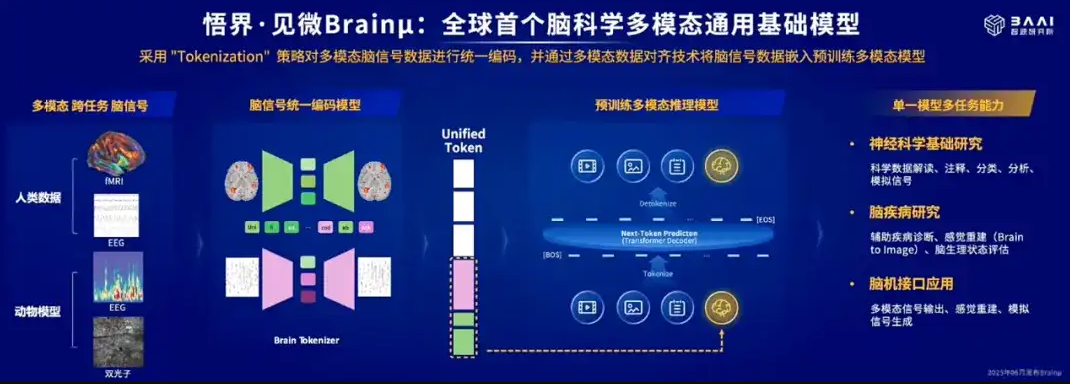
See Microbrainmi, combined with brain science and AI technology, for a generic multi-modular basic model designed to simulate the cognitive mechanisms of the human brain. By integrating visual, hearing and linguistic data, the model can achieve closer human intelligence reasoning and decision-making. See Microbrainmi for a wide range of applications in the fields of medical, educational and psychological research.
From multimodular Emu3, brain science, see Microbrainmi, smart RoboOS 2.0 and RoboBrain 2.0, to OpenComplex2 of life sciences, these models cover multiple frontier areas of AI, opening new opportunities for health, education, industry and biomedicine. The implementation of the open source strategy in particular will accelerate the synergistic innovation of the global AI ecology.

Related Posts

Turkey’s mobile game market earned $347 million in 2025. Dollar

Supercell will fully acquire Merce Mansion’s developer Metacore, with 160 staff reductions.