Q1 in-house purchases in 2026 amounted to $20.5 billion, a 12 per cent decrease in downloads over the same period
According to the latest report of the M&A consulting firm Aream, purchases within mobile games stabilized at $20.5 billion in the first quarter of 2026. According to Sensor Tower data, this represents a slight increase of $20.4 billion in the first quarter of 2025, which is essentially the same as $20.2 billion in the middle quarter, $21 billion and $20.6 billion.
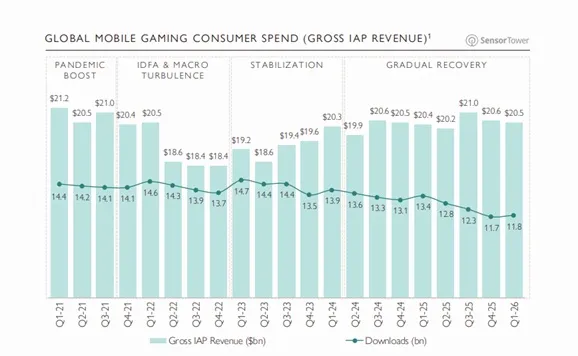
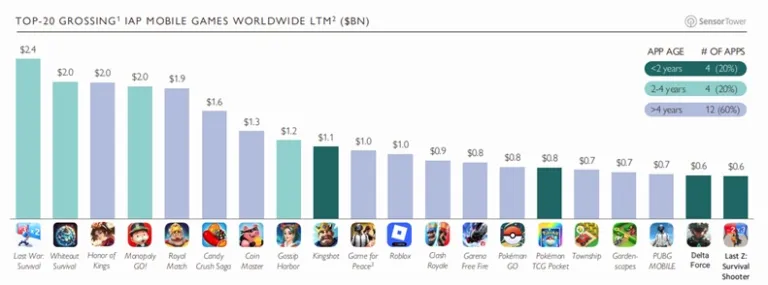
The number of game downloads in the first quarter of 2026 was 11.8 billion, down 12 per cent from the previous year ‘ s 13.4 billion. Downloads continued to decline throughout 2025: 12.8 billion in the second quarter, 12.3 billion in the third quarter and 11.7 billion in the fourth quarter. In the 12 months up to March of this year, Last War: Survival became the highest-income game with $2.4 billion in domestic purchases. Followed by Whiteout Survival, Glory of the King and Monopoly Go, about $2 billion each, and $1.9 billion for Royal Match.
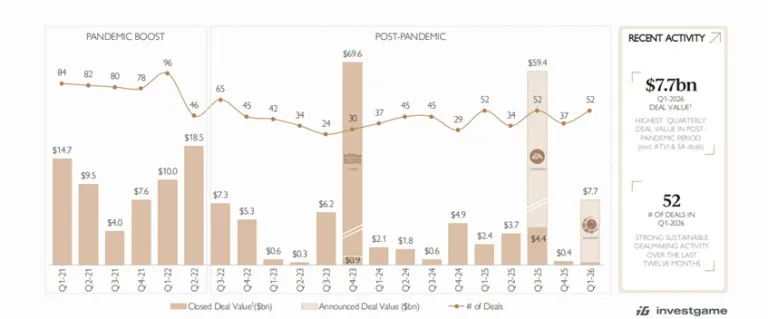
China ‘ s distributors accounted for the largest share of domestic purchases in the 12 months tracked, reaching $26.5 billion (0.6 per cent over the same period). United States distributors ranked second with $10.9 billion (14 per cent decrease over the same period), followed by Japan ($8.1 billion, 0.1 per cent decrease over the same period), Singapore ($4.5 billion, 22 per cent increase over the same period) and Turkey ($4.4 billion, 28 per cent increase over the same period). According to InvestGame, in the first quarter of 2026, the value of mergers and acquisitions in the game industry amounted to $7.7 billion, of which Savvy purchased pupil technology for $6 billion, and Spopely purchased Loom Games for $1 billion. This is the highest quarterly turnover in the post-epidemic era (excluding the quarter in which the blizzard and the utensils were acquired).
The report also estimates that public equity financing in the first quarter was $1 billion, a 68 per cent decrease from $3.3 billion in the same period the previous year, while private investment increased by 42 per cent over the same period, from $500 million to $800 million.