
The founder of the Indian game platform WinZO vs. the Enforcement Bureau, proposed to transfer the investigation to Delhi
The joint founder of the Indian platform WinZO, Saomya Rathore, recently filed a lawsuit with the High Court of Karnataka, challenging the jurisdiction of the Enforcement Bureau of the Government of India to conduct a money-laundering investigation into the platform. Saumya Rathore requested that the investigation and related proceedings be transferred to Delhi, where WinZO ‘ s core business is located. The High Court of India has instructed the Enforcement Bureau to maintain the status quo until the next hearing on 14 January.
The case was heard by a Full Court headed by Judge M. Nagasanna. After hearing the parties ‘ initial submissions, the Tribunal scheduled its next hearing on 14 January and instructed the Law Enforcement Authority not to take action that could have irreversible consequences during that period. This means that, pending further consideration by the Court, that body should not advance key measures that could lead to a sudden change in the situation. On behalf of Sajan Poovayya, counsel for WinZO argued that the law enforcement authorities should investigate in Delhi. He submits that WinZO ‘ s operations, bank accounts and employees are located in the capital district of Delhi and that all the key acts in this case occurred in Delhi. Noting that the 14 bank accounts frozen in the present case were all located in Delhi, he questioned why the Enforcement Bureau had chosen to move the proceedings from Bangalore in the presence of an office in Delhi, stressing that “the choice of jurisdiction cannot be decided by the investigating body alone, but must be based on the principle of territorial connection.” Madhu N Rao, the lawyer representing the Enforcement Bureau, challenged the admissibility of WinZO’s complaint and requested no relief from the Court on the ground that the investigation was “at a critical stage”. He informed the Court that approximately Rs. 80 billion (approximately $99 million) of the assets had been seized in the case and emphasized that the Enforcement Bureau, as a national body, had statutory powers of interstate investigation. WinZO clarified on behalf of counsel, Sajan Poovayya, that WinZO did not challenge the investigative powers of the Enforcement Bureau and that the dispute was limited to the place where the investigation was conducted. He stressed that none of the alleged violations occurred in Bangalore, where only summonses and arrests by the law enforcement authorities were involved. The hearing also referred to the arrest of another co-founder of WinZO, Paavan Nanda, who has now been released on bail, while Paavan Nanda remains in judicial detention under a remand order from the Bangalore court.
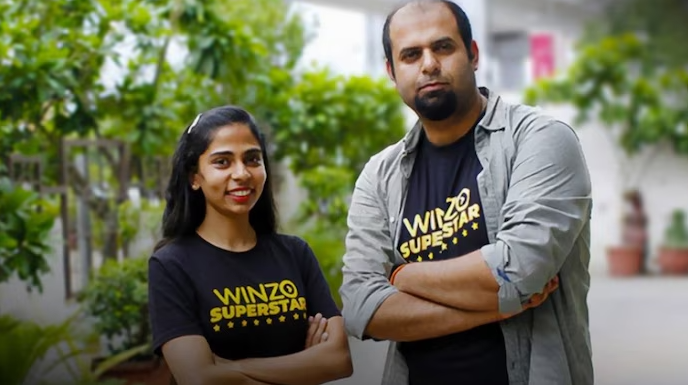
Saumya Rathore (left) and Paavan Nanda (right)
Sajan Poovayya argued that the Bangalore Court lacked territorial jurisdiction and that the case should have been heard by the Delhi Court. When the judge stated that it appeared that bail was sought for Paavan Nanda ‘ s disguised appearance, Sajan Poovayya stated that the relief would be sought in the appropriate court of first instance.
Saumya Rathore ‘ s complaint revolved around the Enforcement Case Information Report (ECIR) submitted by the Enforcement Service. The complaint stated that the report was based on four First Information Reports, of which the cases registered in Bangalore had been suspended, the cases registered in Rajasthan had been closed and the remaining two were from Delhi and Rajasthan, respectively. The complaint asserted that none of the reports disclosed the proceeds of crime or elements of money-laundering and alleged that the fifth report, registered in Gurgon after the submission of ECIR, was “a hypothetical and lacking factual basis”. The complaint also argued that the Bangalore Court had no jurisdiction over the case initiated by ECIR of the Enforcement Bureau. The High Court will reopen the case on 14 January.